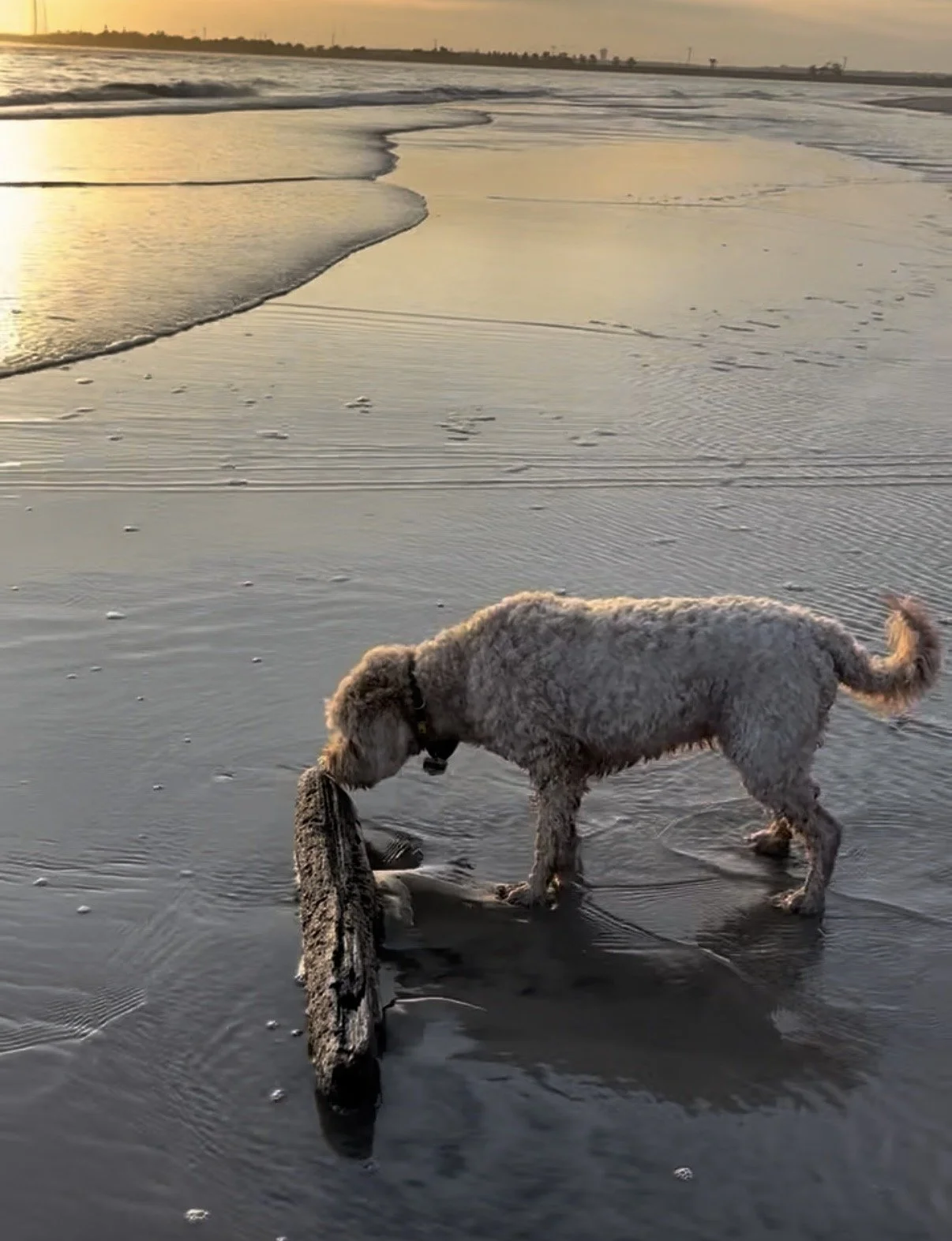
Lord, make me like a dog…
Haphazardly intent.


I am reading Eugene Peterson’s biography for the second time. Someone just said to me, “When I hear someone say they are reading a book for the second time, I write the title down.” Eugene’s biography, written by Winn Collier, is called A Burning in my Bones. I suggested this to the ladies in my book club when we met at the start of the year, each of us, arms full of stories to offer up for a vote. We began with Flannery, and we will end with Flannery. In the middle, we read Wendell Berry, Madeline L’Engle, the new Sci-Fi Project Hail Mary, the classic, The Lion, the Witch, and the Wardrobe, and poetry for Advent and Lent. So here I am, again, with Eugene. So much more the second time around…
I have said it many times, this man’s words and manner have reshaped me in much-needed, unexpected ways as I have walked into the disorienting second half of life.
I guess what I want to convince you of up front is that real theologians don’t make God more complicated but less. They clear the ground. They simplify our lives, not clutter them (Eugene Peterson, The Wisdom of Each Other).
Most of us slog through the clutter and chaos of our days, hitting the bed exhausted and numb. Complicated theology that’s disconnected from our humanity becomes a burden to bear rather than a source of connection and peace. After leaving a career in the classroom for 20 years and a long stretch of burnout, the soil underneath me had been tilled. I was set up and attuned to receive the ministry of this book, to be drawn into the story of this man’s way of listening and living.
Less heady, more earthy.
The beautiful description of the Montana landscape immediately pulled me in…the stories of Eugene spending hours listening to his animated, Pentecostal mother preach in those Kalispell Granges to gritty loggers and miners…the tales of chopping up meat in the butcher shop alongside his emotionally unavailable father…these were cornerstones in the formation of the man. But front to back, there is a sweeping account of God’s presence and movement.
What is essential is to know that the Christian life is mostly what is being done to you, not what you are doing (The Wisdom of Each Other 32).
Simple truths are my new favorite thing. Making sure I have all the answers to all the questions has left me feeling trapped in a maze, pressured to make the right turn in order to finally locate God in some tucked-away back corner. As if it’s all up to me. What Eugene does is clip off and pull out the ramble that has entangled itself around the relational heart of God. All the extra packing around the simple Gospel, all the mess we’ve made of it.
You must feel it too. Jesus’s pursuit of us, his unbending love and compassion, linger in the background, difficult to retrieve when we falsely believe that God’s faithfulness depends on ours. It’s as if we forget the main thing is “Jesus loves me this I know.” Our posture is often a pining one. Not only does he give wisdom and strength generously, but he gives himself in the most unorthodox, sneaky ways. So ordinary, we don’t even realize he’s there. His faithful love is the great Niagara Falls; it will never run dry. We lose touch with his goodness because we’re trying every which way to figure things out, to do everything the “right way.” Learning and “correct thinking” replace companionship with Jesus.
This brain-forward faith rolls out in two unfortunate ways: theology becomes so sterile that it disconnects us from our emotions and the very real complexities and doubts we carry. Or we dehumanize it, oversimplify it with shallow, “bumper-sticker” clichés that leave us empty. Likewise, it leaves the watching world put off. Humanness, emotion, and embodied living are often shut down or dumbed down in the name of answers and sense-making. Mystery is so unsettling to us control freaks. The truth is, God doesn’t always make sense. And many stories, including my own, have revealed the hard truth that he may not do what we want him to do. I hate this, but it is reality. My response? Bring that raw, full-bodied emotion straight to him. As my counselor says, “Vulnerability leads to connection.” I can’t solve it; I bring it.
Incarnational Presence
Eugene has quietly and slowly led me out of such a sanitized, controlled, and disconnected perspective. He has taught me to be awake. He has mentored me into an entirely new way of seeing my life. He has reminded me that incarnation is still the way of Jesus. I love how James K. A. Smith describes it: “This notion of incarnation is behind traditional Christian understandings of the sacraments—the conviction that material, embodied stuff mediates the eternal and divine (You are What You Love 101). And here is how Eugene says it…
The life of Christ emerges from within the actual circumstance of our seemingly very unspiritual lives—the daily stuff of ordinariness and accidents and confusion, good days and bad days, taking the humdrum and the catastrophic both in stride (Wisdom of each Other 53).
Christ emerges…
…today, in your run-of-the-mill, seemingly boring, or intensely demanding day, Christ will emerge.
If you read Eugene’s stuff, you know he memorized the Psalms, he read Scripture for hours each day, he would light a candle, get on his knees, and listen to God; he was a Hebrew and Greek scholar. He translated the entire Scripture into a language that would be accessible to anyone—an earthy text, to say the least. He was smart. He enjoyed learning. But he saw the danger of a faith stuck in the head—he warned seminaries of this very thing. He warned pastors. He regularly checked himself.
Eugene felt adrift. He felt disconnected from the physical stuff of his life: the family he loved, the land he loved, the physical labor and exertion he loved. He felt he’d become a successful pastor but not a very good human (Burning in my Bones 140).
I have sat with several clients and friends who testify about the slow process of being unfurled from a theology that developed out of the tainted soil of overthinking and fear. Exhausting fear. Exhausting because fear always leads to control. So, for many of us, our default became: “Be good, do better, behave.” Many of us adopted the thought, “If I follow his way, life will go well. If not, I will reap the consequences.” Ironically, Scripture tells an opposite story. The prodigal sons (and I do mean that to be plural) story is just one example. A faithless guy was welcomed with warmth and affection, a rigid and arrogant son was invited to a party. My parents, thank the good Lord, did not teach me this, but this has been the mantra of the Christian subculture. It still is, unfortunately. At the core, “being a ‘good’ Christian” (whatever that means) has become a false religion that many followers of Jesus have embraced. Without realizing it, we have come to think behavior is the primary thing, in fact, we get in the driver’s seat, thinking our good behavior controls Almighty God.
Eugene flips this on its head.
The assumption of spirituality is that always God is doing something before I know it. So the task is not to get God to do something I think needs to be done, but to become aware of what God is doing so that I can respond to it and participate and take delight in it (Sue Monk Kidd, quoting Eugene in When the Heart Waits).
“God isn’t compatible with machinery, and scientific medicine, and universal happiness. You must make a choice. Our civilization has chosen machinery, and medicine, and happiness.”
It’s why I write so often about cultivating a rhythm of silence. How in the holy world will we ever notice God when we never slow down? Jesus talked often about “eyes to see and ears to hear.” Silence, stillness, powering down the noise, and allowing our bodies to attune to natural sounds…even those stirrings within us…these are essential to noticing the presence of God.
Getting comfortable with silence will happen as we practice it. And the more comfortable we are with silence, the more aware we are of his activity and companionship.
Vocational call is an interesting thing. I work with seniors in high school and have for every year of my adult life. They live at the edge of their unknown future. The intense pressure is consuming. What am I supposed to do? Where am I supposed to go? Without meaning to, we have taught them to pray really hard, and “God will show you exactly which college you should go to.” The subtle message, the one not stated, is “If you don’t really pray and listen, you could make a wrong choice and fall off God’s path for your life.” We wouldn’t say we believe this, but we live as if we do. We grasp for the right answers. We think of God’s will as fixed and safe, a direction we can figure out. A straight line, if we make all the right choices.
Whew, my friends, life knocks us right off the map.
Think pilgrimage. Think ongoing twists and turns. Think dark woods and valleys of fog. Think scenic views and overlooks. Think waiting. Think sharp turns and unexpected stall-outs. Think lush meadows and birdsong. Think slow. Think arriving and leaving. Think paths through ramble and others paved and worn. Think rest and work, labor and Sabbath. Think ordinary.
Wendell Berry, who Eugene loved, shares this perspective in the winding story of Jayber Crow (I would HIGHLY recommend this book!):
If you could do it, I suppose, it would be a good idea to live your life in a straight line…But that is not the way I have done it, so far. I am a pilgrim, but my pilgrimage has been wandering and unmarked. Often what has looked like a straight line to me has been a circle or a doubling back. I have been in the Dark Wood of Error any number of times. I have known something of Hell, Purgatory, and Heaven, but not always in that order. The names of many snares and dangers have been made known to me, but I have seen them only in looking back. Often I have not known where I was going until I was already there. I have had my share of desires and goals, but my life has come to me or I have gone to it mainly by way of mistakes and surprises. Often I have received better than I have deserved.
Often my fairest hopes have rested on bad mistakes. I am an ignorant pilgrim, crossing a dark valley. And yet for a long time, looking back, I have been unable to shake off the feeling that I have been led—make of that what you will (Jayber Crow 133).
This is Eugene’s story. This is mine. This is yours. Winding and wayward. And the longer you live, the longer your timeline, the more obvious this becomes. It’s not that all of it makes sense; it’s that God is doing what you cannot do. And he is doing what he is doing as you live your humdrum life. Eugene spoke about his life as a dog following a scent. Head down, sniffing out the presence, the active and ongoing movement of a friendly God. Winn describes Eugene sharing more about this view when looking back at his life:
Eugene's talk, "Intently Haphazard," echoed a line from a piece of Levertor's "Overland to the Islands" that Eugene returned to over and over again. The poet's picture of a dog following its nose without any clear direction captured him.
The imagery spoke to him so deeply because he had been that dog for decades. His life and work had been more like tracing a scent than following a map. Discovery, not direction. In all those fifty-five years, Eugene had never truly mapped his future, never tried to lay some ordered path toward a clear career goal. Intent? Sure. But haphazard too. The whole meandering journey had been a dog sniffing the wind, the next whiff being the only real clue. And what had been the scent? Holiness? The Presence? (60).
What if we woke up each day with this way of being in the world? What if it’s true that God still comes into our lives through the stuff of real things, people, his creation? Things we don’t control or map out. What if daily bread is the thing, after all?
What if we told our kids, “Look at the dog! Be like him!” What if we taught our kids to look and listen? To wander and notice? To listen to the birds…to wander in the deep woods…to stare out at the broad sea? What if we lived so aware of the goodness of God in the present that, in the watching, they learned to sniff out the presence of God? What if we pointed out Jesus in the waitress, the mailman, and their teacher? Oh, to live knowing, deep in our bones, that God is with us in the unpredictable journey.
It reminds me of this stanza from Gerard Manly Hopkins’s, “As Kingfishers Catch Fire,”
I say móre: the just man justices;
Keeps grace: thát keeps all his goings graces;
Acts in God's eye what in God's eye he is —
Chríst — for Christ plays in ten thousand places,
Lovely in limbs, and lovely in eyes not his
To the Father through the features of men's faces.
What if we were influenced by our dogs? No linear path, just following a scent, one whiff at a time…
“Every time Jesus healed, forgave or called someone, we have a demonstration of shalom. And “shalvah,” security. It has nothing to do with insurance policies or large bank accounts or stockpiles of weapons. The root meaning is leisure-the relaxed stance of one who knows that everything is all right because God is over us, with us and for us in Jesus Christ.”