
"What is essential is to know that the Christian life is mostly what is being done to you, not what you are doing."
— Eugene Peterson
We had a busy October. It seems to be the best time for visitors since the Pennsylvania landscape is an in-person kind of thing. The roads that weave through Chester County are a destination in and of themselves. All you need is a good drive, and your soul will fill up.
We drove Creek Road to the Brandywine River Museum one weekend when our dear friend was in town from Ohio. We wandered about the rooms peppered with landscape views of the Brandywine Valley, a mix of artists from the Hudson River School, including my favorite, Andrew Wyeth. We had to pause when a painting brought up that swell of mystery and joy.
Art does that. You don't rush past a painting like this:

Jasper Francis Cropsey (1823–1900),Autumn in the Ramapo Valley, Erie Railway
We took our time, and while I lingered in the gift shop, Scott made his way out to the courtyard to wait for us. Among the rows of empty chairs, he spotted a small chrysalis hanging under the corner of one of the seats. So small and fragile. So perfect and beautiful. Soon enough, the crowds at the next outdoor event would put this little creature at risk during its most vulnerable time of transformation.
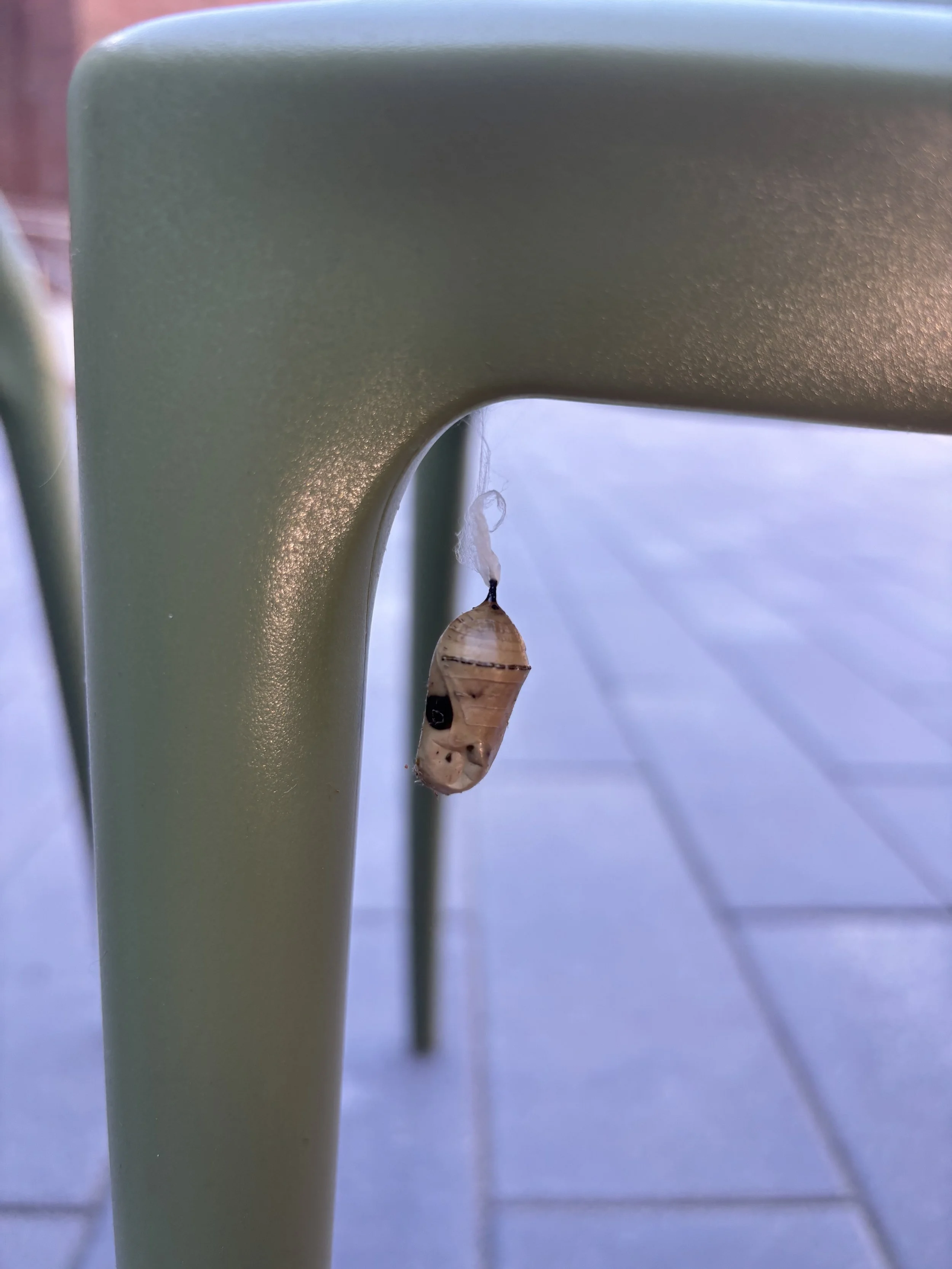
The Chrysalis at the Brandywine River Museum
Scott's problem-solving skills were activated. He gently unhooked the tiny creature from the seat and scoped out the wild space around the courtyard. Surrounded by native foliage, he spotted a patch of wildflowers, soft and welcoming, yet sturdy with some October crisp, willing to secure this life into its next phase. Looking around, Scott borrowed some spider webs stretched along the shrubs and wrapped them securely away from harm. We had to protect the waiting.
I still think about that little guy. I wonder how he fared as the days grew shorter and the nights longer. Attentiveness to God's creatures makes us attentive to our own lives.
We all know the waiting can be arduous. The older I get, the more it seems we take one of two roads when presented with the challenge of waiting. Avoid it at all costs (literally, money, physical health, mental health, relationships, connection with God…).
Stay busy, keep the noise turned up. If we do stop, we scroll or sleep.
The other road is a winding way: submission and surrender. Stay still, be silent, pray, listen to the Spirit, be alone, and reflect. It’s not “productive,” and it can feel awkward, even irresponsible. To surrender is to receive. To be still is to allow the transformation to deepen. It may feel impossible to settle down the brain and body at first, but then comes the calm you didn’t know you needed. A calm that feels foreign until it feels right.
We must take thoughtful care in the process of becoming. God will do the work, but we must learn to remain, to resist the temptation to squirm and bolt. His crucial work germinates in the dark, quiet spaces.
“It comes the very moment you wake up each morning. All your wishes and hopes for the day rush at you like wild animals. And the first job each morning consists simply in shoving them all back; in listening to that other voice, taking that other point of view, letting that other larger, stronger, quieter life come flowing in. And so on, all day. Standing back from all your natural fussings and frettings; coming in out of the wind.”
I appreciate how Advent realizes the complicated unpredictability of our lives. The human parts. Advent isn’t sentimental; it is an odd invitation to do what is completely unnatural to do: stay and hope when we have no reason to hope.
Remain.
We look to God to bolster our trust and hope; it’s not our job. As much as our culture wants to feed us the message that we have all we need in and of ourselves, we can’t increase hope. The only thing we can do is give him the space to multiply the mustard seed.
As I write this reflection, our first snow is swirling about Chestnut Street. My quiet mornings must be by a window. The feeders are full, the draft from this late 1800s house is stayed by a thick blanket. I am present. Or at least, I am trying to be. Once I rush out the door, if I don’t have that hour, I’ll likely not think of him in the zig-zag of the day. I want so much to be attuned to God.
The complicated things, the undone things, the regretful things, the sorrowful things…these make their way to the surface when we sit in the waiting. The temptation is to hurry, and subsequently, we are pulled out of the moment where God is and into a day we try to control. We dart and jump, we twist our bodies and duck; life, for many of us most of the time, is a game of dodgeball. We make every move, awkward as it may be, to avoid waiting.
Yet, when we avoid waiting, we avoid feeling. And when we avoid feeling, we disconnect from ourselves, others, and most importantly, God. Out of touch, we begin to live like robots. Advent is a time to return to our humanness, our need for a Savior.
“It is easy for me to imagine that the next great division of the world will be between people who wish to live as creatures and people who wish to live as machines.”
Sometimes the waiting is intense. Waiting on test results, waiting to get pregnant after years of trying, waiting on a company to contact you after the second interview, waiting to finally feel at home in a new place with new people, waiting and watching through political unrest. Waiting to feel better. We must carry these excruciating times together.
Most of the time, waiting feels pointless. It’s like an in-between, useless part. Our entire consumer culture is designed around making these spaces shorter. It’s strategic. We hate waiting, and we will pay extra not to have to. The essential things, the good things, the important things…these matter, but waiting in the middle is a wasteland. And yet, our days and nights are strung together with these ordinary gaps. Maybe God sits in these middle spaces. Maybe he establishes our roots in that wasteland.
Can you sit for a few moments, even now, and recall a time of waiting—a period of unknown, a time when you felt stuck, no movement seemed to be happening? What did God fashion? What strength? What gratitude resulted? What appreciation for someone or something? What relationship came? What thing were you able to surrender? Did you loosen your grip on control? Was there a new level of empathy dug out in your soul? Dependency on the Spirit instead of your own ideas?
God the Father is the opposite of the consumer culture. Notice the trends, and you can probably assume he values the opposite. From Genesis to Revelation, and in the pages of your own life that you just recounted, it’s clear—He does not “fix” waiting. In fact, he places a high value on the discipline of endurance, patience, and watchfulness in the waiting.
Isaiah 9 is an oft-quoted passage during the Christmas season.:
“The people walking in darkness
have seen a great light;
on those living in the land of deep darkness
a light has dawned.
You have enlarged the nation
and increased their joy;
they rejoice before you
as people rejoice at the harvest,
as warriors rejoice
when dividing the plunder.”
Our entire faith is built on the reality that God promised to send a Messiah, and he delivered on his promise.
"The people walking in darkness have seen a great light..."
The angels blazed with their announcement. A good King, a King motivated to love and serve, was coming to reign! This was the good news for all people…
But let us not forget the long darkness endured.
I know many people who stumble in the darkness these days. People who are waiting in unknowns and unresolved things. They are aware and grateful for the larger story: Creation-Fall-Redemption. Most of us know intellectually that this present reality is not the whole story. And, furthermore, this larger view really matters. But the day-to-day suffocation of unknowns, or grief from the knows that ended in tragedy--this darkness is real.
Lord, have mercy on us.
God suffers with us in the darkness.
Receive.
I’d love to eavesdrop on Jesus when he was at Mary and Martha’s home. What was he saying to Mary when she sat on the floor by his feet? Amidst the anticipation of guests and food prep, she zoned in on him. It must have been similar to that fixed concentration when the pages of a book are so engaging you lose all track of everything. Many of us know this story well. Though not a typical Advent account, Mary’s posture is praised by Jesus. That’s something to notice. She was not grasping for control; she was not circling in haste. Mary got caught up in the attention and presence of Jesus. Mary was receiving the goodness of the presence of God.
The pause is the chrysalis, my friends. A lot happening in what feels like futile space. God moves into the tucked-away parts of us, and while we wait, he transforms. Removing some bitterness, increasing hope, shedding some control, softening the edges, and building trust in him when trust has been elusive.
Transformed.
When we remain, we receive the grace of metamorphosis. When I cease striving and instead position myself under the influence of the Holy Spirit, transformation is a reality. Over time, and bit by bit the long list of unhealthy default responses to stress, the bitterness that has taken a deep root, the self-absorption of the culture shaping all of us, the fears that turn to control, the love of money, the subtle self-sufficiency…these become less true of us.
A Christmas miracle, to say the least.
Scripture provides us with good company. We have the long view of the lives of those who waited, and waited, and waited, slowly changed by the faithful work of God:
The Israelites’ long pilgrimage in the desert.
Daniel in exile in Babylon.
Paul in prison.
Job in the ashes.
Jonah in a whale.
Mary spent regular time at the synagogue hearing the Torah read aloud. Week after week, month after month, and year after year. She became attuned to God’s ways, his heart, and his lovingkindness. Attentiveness made her ready to receive. Gabriel, who describes himself as one who “stands in the Presence of God,” said to her,
Do not be afraid, Mary; you have found favor with God. You will conceive and give birth to a son, and you are to call him Jesus. He will be great and will be called the Son of the Most High. The Lord God will give him the throne of his father David, and he will reign over Jacob’s descendants forever; his kingdom will never end.
God used the womb of a young woman to enter the story of humanity. His way was not a quick way. And Mary’s hidden, dark womb would be the space where the Promise of God would manifest and form. Mary received the plan of salvation and carried him in her body. Her response to Gabriel was simple:
“I am the Lord’s servant,” Mary answered. “May your word to me be fulfilled.”
Let me include here, again, the quote with which I opened this reflection; it is profound and has the potential to completely change how you view your life with Christ:
What is essential is to know that the Christian life is mostly what is being done to you, not what you are doing…We become Christians because we realize we cannot save ourselves and need Christ to save us. But once we are “in” we start taking over the job (Eugene Peterson, The Wisdom of Each Other).
What does it look like for me to be a recipient of God’s presence? To be in these waiting times accessible and open to his favor? To look and listen? To be quiet and calm? To be so with him that I know his voice? To live in the awareness that I am receiving not only himself through his Spirit, but his work of transformation?
As my dear mentor Henri Nouwen reminds me, “Something is growing under the ground on which you are standing.”
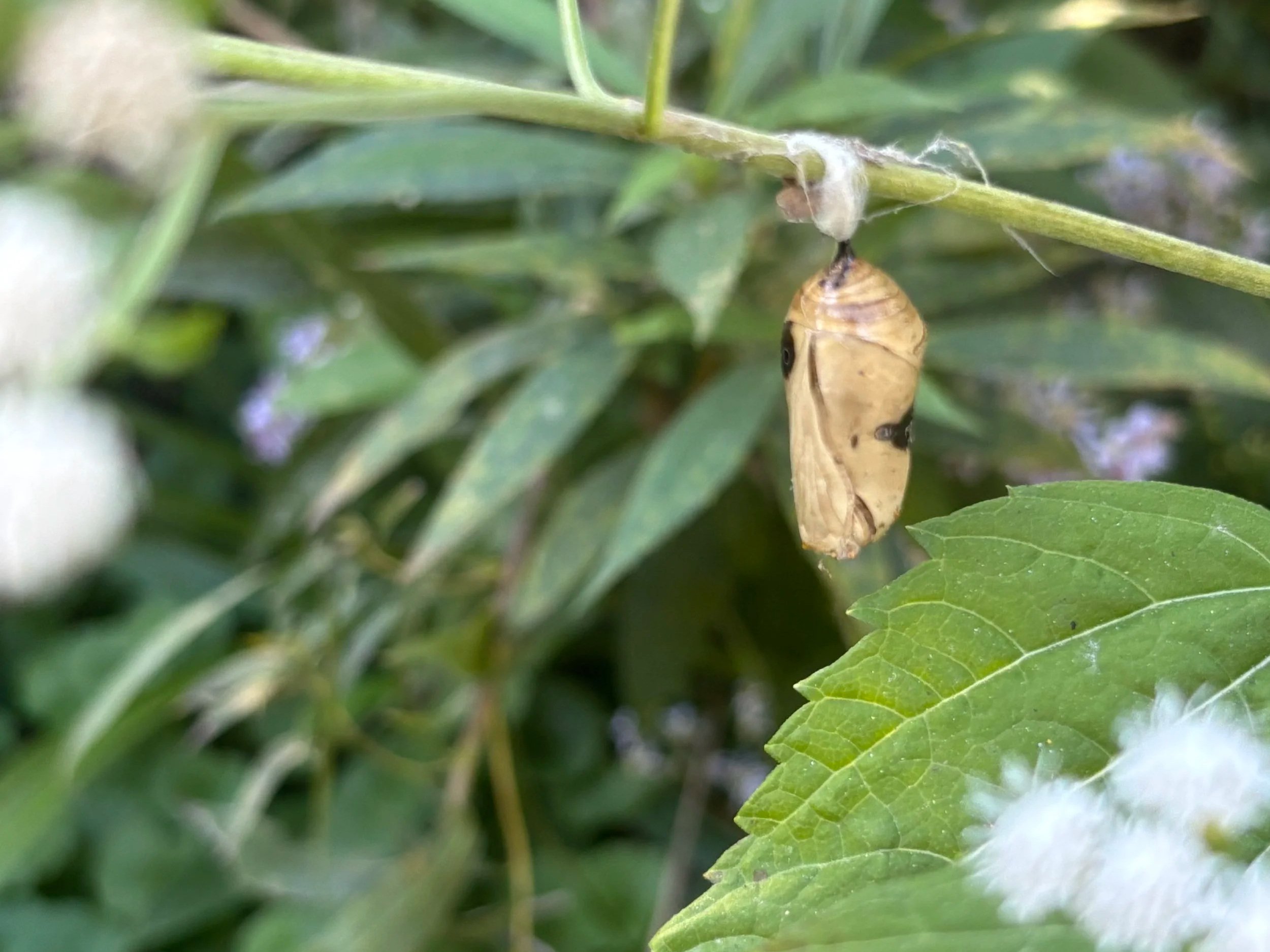
This was the safe spot Scott found for the fragile chrysalis…
A Prayer if You have no Words:
Lord, waiting is strenuous. I want to speed things up. I want to fix the stuck parts. Not just for me, but for so many people in my life. Have mercy, I struggle so much with letting the story unfold without my strategies and manipulation But you, Lord, are the author, and you are the one who knows all things. May I rest in you. May I find security in your slow work. I sit here today with my palms open in surrender. I receive you. Just as you said to Abraham, may I remember—YOU are my great reward. Change me, and change me into who you designed me to be. As I enter into the Christmas season, may stillness, openness, and surrender characterize me. Give me an attentiveness to your Spirit.