“This is a necessary journey to travel: the dark night must be lived through, the hard questions asked, the great issues grappled with.”
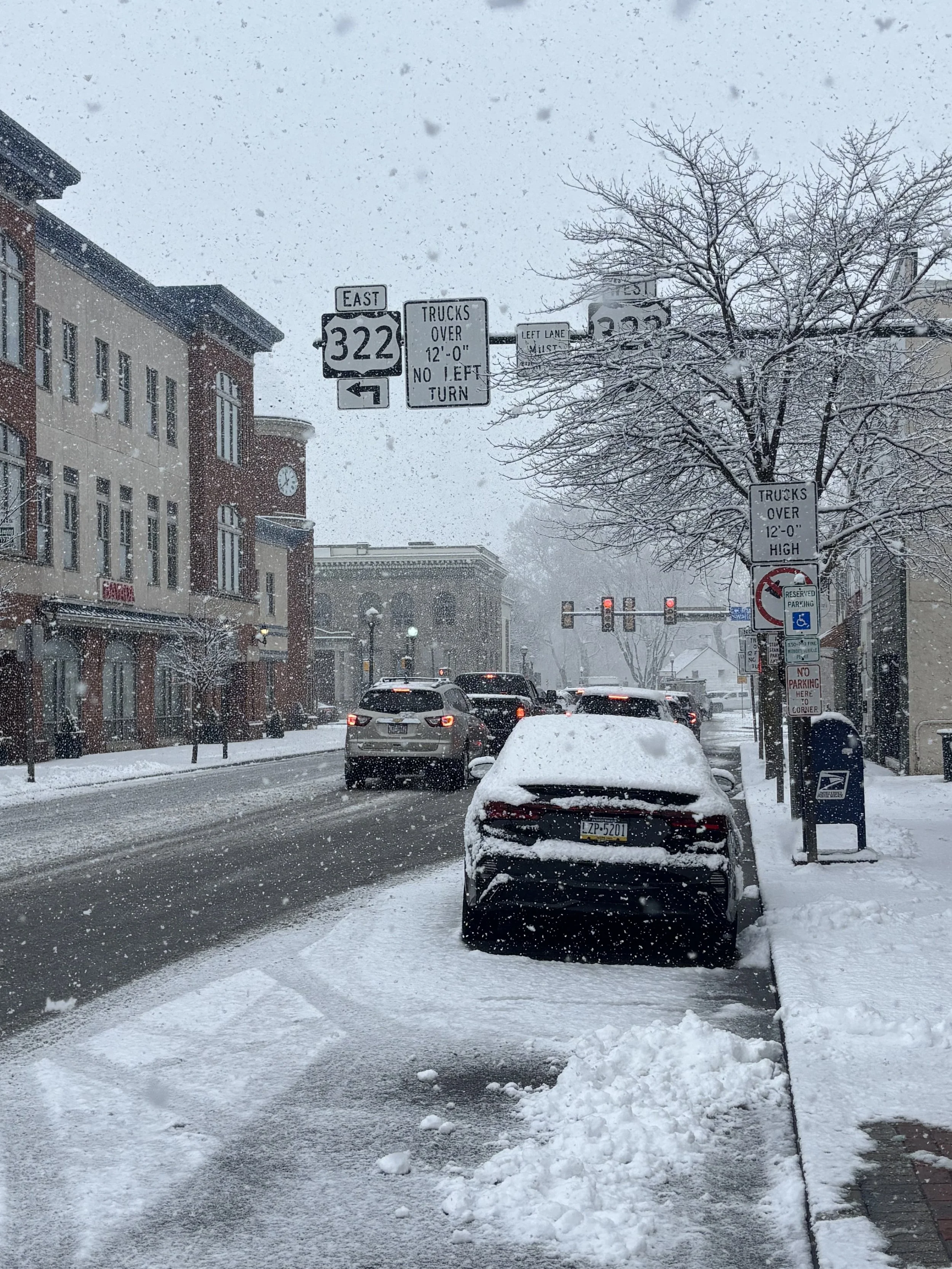
The start of the storm.
"The lights are extinguished for the scene to be changed."
T.S. Eliot, The Four Quartets
Our ground is frozen over with the leftovers from the winter deluge that hovered over Pennsylvania, dumping just under 10” of snow a few weeks ago. The day was an ongoing feat to manage what was falling, boots off and back on, gloves off and back on…hat, vest, coat, scarf…We shoveled our sidewalks at least 4 times. We shoveled it from one inconvenient space to another. And that wasn’t all, for an hour and a half, load by load and bit by bit, I scooped out the snow that had compacted and gathered under, over, and around my car. My back ached as I hauled every scoop to the other side of the street. There was nowhere else to put it (We live in the borough of Downingtown, no fun in a winter snowstorm). Like a middle-school boy playing a joke, the wind unexpectedly blew the snow down my neck and into my face. It was too much cold.
This storm spun out at the end with his cruel retribution pouring an hour of sleet over every hill, tree, sidewalk, and road. The powdery snow turned thick and dense; everything was challenging. Now, mountains of snow piled up in the middle of the parking lots and on the corners of every street; I feel like I live on the moon. Roads are narrow. Sidewalks are lined with frozen-over chunky mounds. Forget getting in the passenger side of the car!
The human condition can feel like a curse. Burdens pressed down with guilt, sorrow, and fear blanket us thick and unmoved. How do we thaw? Where do we put the overwhelm we carry? Does God care? Will he offload this oppression? Frederick Buechner reflects on the words of one of his impressionable professors from Union Theological Seminary in NYC named James Muilenburg:
“Every morning when you wake up,” he used to say, “before you reaffirm your faith in the majesty of a loving God, before you say I believe for another day, read the Daily News with its record of the latest crimes and tragedies of mankind and then see if you can honestly say it again.”
Today marks the start of Lent. Christians enter this stretch of the church calendar with the awareness and acknowledgment that the word is broken. We are broken. So, we begin Lent with this universal cry: “Lord, have mercy.” Like my town, stuck under this hefty, frozen snow, we are wedged in and unable to free ourselves. We need the sun to come and melt this tundra of ice. My cold heart. To defrost the rigid layer of my idols. In my lifetime, it has never become more obvious that we are in the wilderness. We are pilgrims who walk in the dark—that of our own making, and that of a world relentlessly committed to the self in the center. We sit in the ashes; we cry out to the only One who can save us from ourselves. We name our limitations. We acknowledge that we are flesh and bone.
“Lord, come, we want you.”
There is a reason the harsh season of winter represents the raw parts of life, those parts we want to skip over. We like to ignore them, pretend they are not real. But thank God for the poets who give us hope while stuck in this cold season; there is a stirring underneath the frozen ground, reminding us that spring will come.
Stand in the field long enough, and the sounds
start up again. The crickets, the invisible
toad who claims that change is possible…(Dana Gioia, from “Becoming a Redwood”)
I have often written about winter. There is beauty in this snow; it falls, tiny crystals swirling about the sky like magic. Actually, the colder seasons are my favorite. But wow, the freezing temperatures can slowly bend us over to exhaustion, even despair. We can’t make it go away; all we can do is endure it. We wait in surrender for someone to come and warm us.
Today, we smear ashes on our foreheads to acknowledge that we were created out of the stuff of earth.
Though we try to be, we are not gods. We are creatures; we have a Creator. In quiet, reflective moments (if chosen), we will notice how often we get the two confused. For all of human history, it plays out in two ways: we sincerely begin to believe we are the master and commander of the ship, OR our fleshy tendency is to identify some “strong and powerful” human as the hero and look to him or her to save us. Typically, it is a combination of both. All the while, we shuffle about, pining and striving, fearful and anxious.
And what is most tragic, we forget about Jesus.
We mistake his Kingdom for a kingdom of power and might. He didn’t come with an entourage; he didn’t come raising his fist and a flag; he came on back roads to wells and walls outside of the city; he came for the looked-over, the ragamuffins. His posture was marked by humility and love. He spoke on behalf of the underdog, those discarded from society, the frail, the feeble, and the vulnerable.
Ash Wednesday is meant to remind us that we are these people, the needy ones, the ones prone to wander. The rabble.
Lent begins here for good reason. In our ashes, Jesus finds us, he comes to us, and invites us into the warmth of his love.
It seems to me that gratitude is full and overflowing when we start in the ashes and end up at the party.
“Then Levi held a great banquet for Jesus at his house, and a large crowd of tax collectors and others were eating with them. But the Pharisees and the teachers of the law who belonged to their sect complained to his disciples, ‘Why do you eat and drink with tax collectors and sinners?’
Jesus answered them, ‘It is not the healthy who need a doctor, but the sick.’”
I invite you to join me in this stretch of days, this Lenten experience. These days are meant to draw us to Christ. This is not about managing sin. It is not about behavior reform.
We are called into the pure love of God.
Surrender is unnatural for most of us. Fears known and unknown have created pathways of control, and those ruts are deep. Rarely have I heard it said this way:
“Jesus’s call to each of us is his call to be aware of his presence, to turn toward him and surrender to his love…Conversion is the lifelong transformational process of being remade into his image. It is so much more than trying to avoid sin. The focus of repentance and conversion is Jesus, not my sin nor my self” (David Benner, Surrender to Love).
Prayer:
“Lord Jesus, draw me close to you. Amidst my resistance and busyness, settle me down so I can be with you. Let me find you in these long weeks of Lent.”